
AI-Proof Jobs Without a College Degree: Recommendation Trends Report 2026
Executive Summary
When people ask AI systems about careers, they rarely ask the same question.
Some ask about salary. Others ask about job security, automation, student debt, apprenticeships, or the future of work.
But after analyzing 50 realistic career questions for workers without a college degree, a surprising pattern emerged:
Many of the recommendation patterns observed in career advice mirror broader trends identified in our report on how AI chooses software winners.
The questions changed, but the recommendations largely stayed the same.
Whether users asked about high-paying jobs, AI-resistant careers, recession-proof work, or future opportunities, AI systems repeatedly converged on a small group of occupations. Electricians, plumbers, HVAC technicians, healthcare support workers, and renewable energy technicians dominated recommendations across nearly every category.
This report explores why AI systems consistently recommend these careers, what recommendation patterns emerge, and what those patterns reveal about the future of work.
The Recommendation Convergence Effect
One of the most interesting findings in this research is what PromptMarketMap calls the Recommendation Convergence Effect.
Across 50 career-related prompts, users approached AI systems with very different concerns:
- How can I make good money without college?
- What jobs are safest from AI?
- What careers will still exist in 2035?
- What jobs can I get at 18?
- What careers don’t require student loans?
Despite the different wording, AI systems frequently returned the same recommendations.
The reasoning changed.
The careers did not.
Questions about salary emphasized earnings potential.
Questions about automation emphasized AI resistance.
Questions about debt emphasized apprenticeships.
Yet electricians, plumbers, HVAC technicians, EMTs, and healthcare support roles continued appearing again and again.
The result is a remarkably concentrated recommendation ecosystem.
The Career Recommendation Leaderboard
Across all 50 prompts, a small group of careers dominated AI-generated recommendations.
| Rank | Career | Appears In |
|---|---|---|
| 1 | Electrician | 38 of 50 prompts |
| 2 | Plumber | 32 of 50 prompts |
| 3 | HVAC Technician | 27 of 50 prompts |
| 4 | Home Health Aide | 24 of 50 prompts |
| 5 | Solar PV Installer | 22 of 50 prompts |
| 6 | Wind Turbine Technician | 20 of 50 prompts |
| 7 | Elevator Installer | 18 of 50 prompts |
| 8 | Certified Nursing Assistant (CNA) | 17 of 50 prompts |
| 9 | EMT / Paramedic | 16 of 50 prompts |
| 10 | Surgical Technologist | 15 of 50 prompts |
The dominance of skilled trades is striking.
Trades generated more recommendations than healthcare, transportation, logistics, or service-sector careers.
Why AI Systems Keep Recommending the Same Careers
Several recurring patterns explain why recommendation systems repeatedly favor certain occupations.
Pattern 1: The Physical Presence Moat
The strongest predictor of recommendation frequency is physical presence.
AI can generate text, analyze spreadsheets, and automate routine digital workflows.
It cannot easily:
- Repair electrical systems
- Install plumbing
- Troubleshoot HVAC equipment
- Respond to medical emergencies
- Maintain infrastructure
The more a career requires real-world physical interaction, the more frequently it appears in recommendations.
Pattern 2: Human Accountability
Many recommended occupations involve safety, regulation, and liability.
Electricians sign off on electrical work.
EMTs make life-critical decisions.
Healthcare workers provide direct patient care.
Even when AI assists decision-making, humans remain responsible for outcomes.
This creates a powerful barrier to automation.
Pattern 3: Demographic Demand
Healthcare careers appear frequently because of long-term demographic trends.
An aging population increases demand for:
- Home health aides
- CNAs
- EMTs
- Patient care specialists
AI systems consistently recognize this demand and elevate healthcare support careers in recommendation rankings.
Pattern 4: Infrastructure Dependence
Modern society depends on physical infrastructure.
Homes need electricity.
Buildings need plumbing.
Businesses need climate control.
Data centers need power and cooling.
Because infrastructure remains essential regardless of technological change, trades continue receiving strong recommendation visibility.
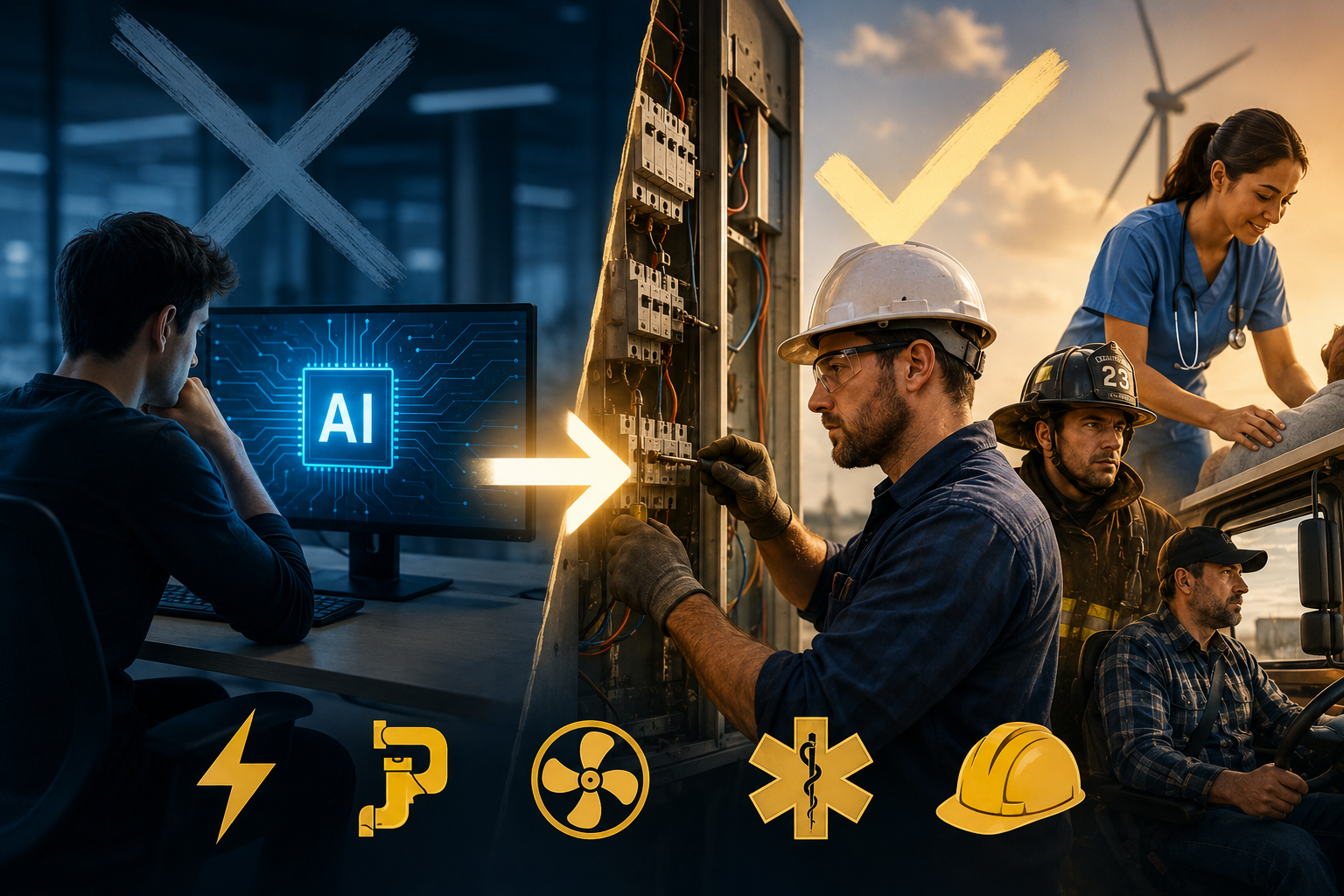
The Trades-Office Inversion
For years, conventional wisdom suggested that office work represented the safest career path.
This research suggests AI systems increasingly believe the opposite.
Many traditional entry-level office roles rarely appear in recommendation outputs.
Examples include:
- Data entry
- Clerical support
- Administrative assistance
- Basic bookkeeping
- Routine customer service
Instead, AI systems frequently steer users toward careers requiring physical presence, practical skills, and real-world problem solving.
PromptMarketMap refers to this shift as the Trades-Office Inversion.
The occupations once viewed as vulnerable to automation are now being recommended as protection against automation.
Similar recommendation shifts can be observed in educational technology, where AI systems increasingly favor specialized tools and platforms.
Emerging Winners
While electricians and plumbers dominate today’s recommendations, several newer occupations are gaining visibility.
Solar PV Installers
Renewable energy expansion is driving increasing recommendation frequency.
Solar installation appears regularly whenever users ask about future growth industries.
Wind Turbine Technicians
Among all emerging occupations, wind technicians appear most frequently in growth-oriented prompts.
AI systems often associate these careers with strong long-term demand.
High-Voltage Infrastructure Specialists
Electric vehicle adoption and grid modernization are creating new opportunities for technically skilled workers.
These roles combine traditional trade skills with advanced technology systems.
The Rise of AI-Augmented Trades
The future may not belong to workers who avoid AI.
It may belong to workers who use AI effectively.
Many recommendation systems increasingly describe careers such as:
- Electrician + AI diagnostics
- HVAC Technician + predictive maintenance
- Industrial Mechanic + machine learning monitoring
- Solar Installer + AI-powered system analysis
In these examples, AI does not replace the worker.
It enhances the worker.
This creates a new category of career resilience: the AI-augmented skilled professional.
The same AI systems reshaping software recommendations are increasingly becoming part of modern trade workflows.
What This Means for High School Graduates
The most important finding from this report is not which career ranks first.
It is the remarkable consistency of the recommendation patterns.
When AI systems receive questions about salary, job security, future demand, automation risk, or educational alternatives, they repeatedly return to the same small group of occupations.
The recommendation logic changes.
The answer set barely changes.
That suggests AI systems increasingly view physical presence, human accountability, infrastructure dependence, and demographic demand as the strongest predictors of long-term career resilience.
For workers entering the job market without a college degree, the message from AI recommendation systems is surprisingly clear:
The future of work may be less about competing with AI and more about doing the kinds of work AI cannot easily do itself.
Key Takeaways
- Skilled trades dominate AI career recommendations.
- Electricians appear more frequently than any other occupation.
- Healthcare support careers remain highly visible due to demographic demand.
- Traditional entry-level office jobs appear less frequently than expected.
- Renewable energy careers are rapidly gaining recommendation visibility.
- AI systems increasingly favor physical, human-centered, and infrastructure-based work.
- Different career questions often produce remarkably similar recommendations.
The result is one of the clearest recommendation patterns observed in PromptMarketMap research to date: when AI systems discuss the future of work, they consistently point toward careers rooted in the physical world.The future may belong less to people sitting behind screens and more to people solving problems in the physical world.