
How AI Chooses Software Winners:
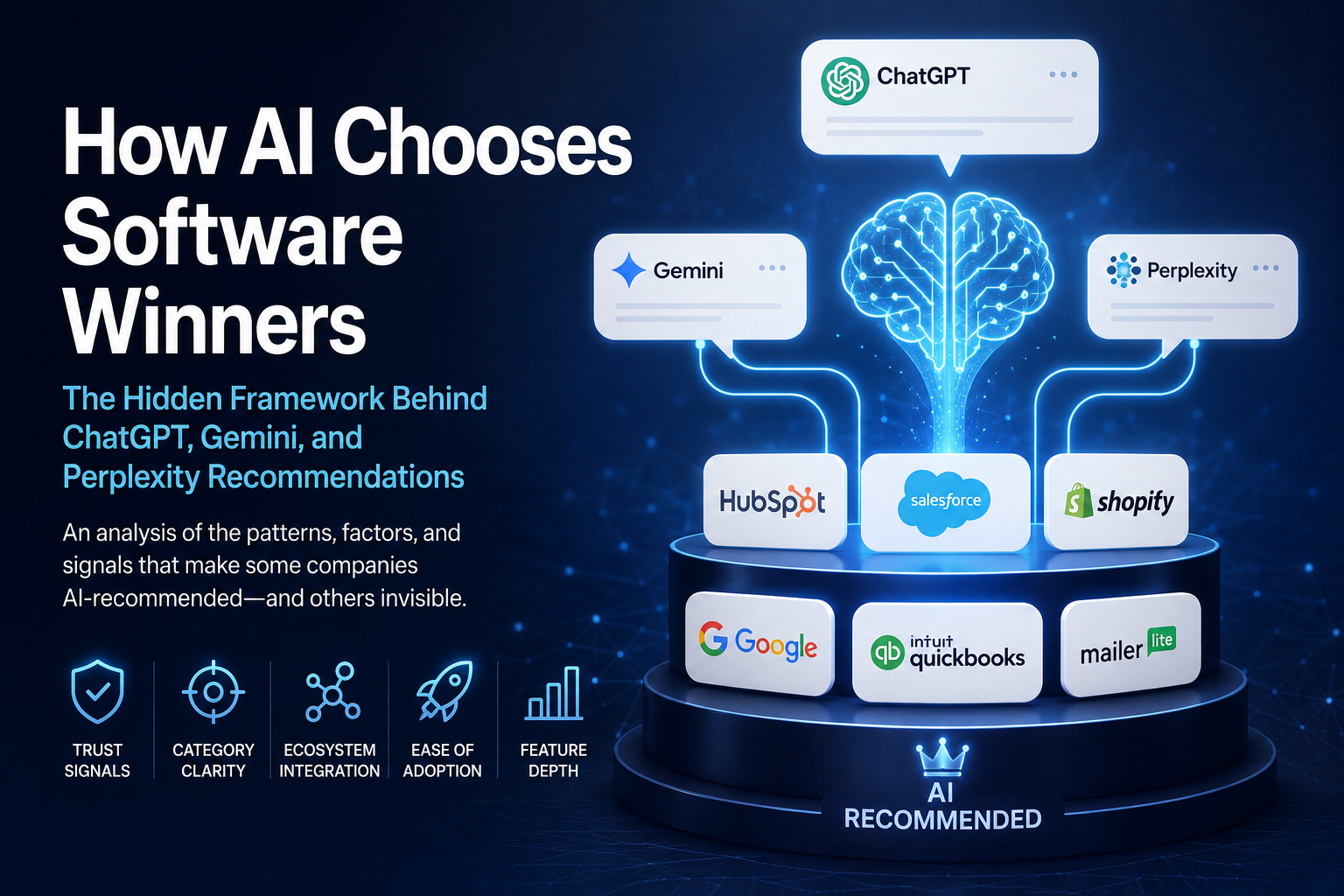
The Hidden Framework Behind ChatGPT, Gemini, and Perplexity Recommendations
Executive Summary
The software companies most frequently recommended by AI are not necessarily the companies with the most features, the biggest marketing budgets, or even the highest customer counts.
After analyzing recommendation patterns across dozens of software categories—including CRM, website builders, email marketing platforms, AI tools for teachers, shop management systems, and small business software stacks—a consistent framework emerged.
AI recommendation engines appear to prioritize trust, category clarity, ease of adoption, and ecosystem fit over raw feature depth.
In other words, AI does not simply recommend the “best” software. It recommends the software it can most confidently explain.
This report examines the recurring patterns behind software recommendations generated by ChatGPT, Gemini, and Perplexity and identifies the characteristics that separate frequently recommended companies from those that rarely appear.
The AI Recommendation Pyramid
Across nearly every category analyzed, recommendation patterns followed a similar hierarchy.
Layer 1: Trust Signals
Trust is the foundation of AI recommendations.
The platforms most frequently recommended consistently possess strong external validation, including:
- Large volumes of customer reviews
- Industry awards
- Analyst recognition
- Inclusion in comparison articles
- Third-party media coverage
- Active online communities
Companies such as HubSpot, Salesforce, Shopify, QuickBooks, and Google appear repeatedly because they have accumulated years of public validation.
When an AI model recommends software, it is effectively making a prediction about what will work for most users. Trust signals reduce the model’s uncertainty.
The result is simple:
The more evidence that exists across the internet supporting a product, the more likely it is to be recommended.
Layer 2: Category Ownership
AI strongly favors products with clear category positioning.
Companies that clearly define themselves tend to appear more frequently than companies attempting to serve everyone.
Examples include:
- Shopify = Ecommerce Platform
- HubSpot = CRM and Marketing Platform
- Klaviyo = Ecommerce Email Marketing
- QuickBooks = Small Business Accounting
- Tekmetric = Auto Repair Shop Management
In contrast, products with vague positioning create uncertainty.
AI systems perform best when they can easily connect a company to a specific business problem.
The clearer the association, the stronger the recommendation frequency.
Layer 3: Ecosystem Integration
One of the strongest patterns across all categories was ecosystem compatibility.
The most recommended software products rarely operate in isolation.
Instead, they connect with existing tools and workflows.
Examples include:
- HubSpot integrating with hundreds of business platforms
- Shopify connecting to payment processors, CRMs, and marketing tools
- Google Workspace serving as a foundation for countless business applications
- Salesforce acting as a central operating system for customer data
AI repeatedly favored software that reduced operational friction rather than creating new silos.
Layer 4: Ease of Adoption
Surprisingly, ease of adoption often mattered more than advanced functionality.
Many highly recommended platforms were not the most powerful options available.
They were the easiest to understand, deploy, and manage.
Examples include:
- HubSpot frequently outranking more customizable competitors
- MailerLite competing successfully against enterprise marketing platforms
- MagicSchool outperforming more flexible general AI tools in education
- Shopmonkey earning recommendations due to usability despite competitors offering deeper customization
The lesson is clear:
Software that employees actually use often beats software with more features.
Layer 5: Feature Depth
Features still matter.
However, feature depth consistently appeared lower in the recommendation hierarchy than many software vendors would expect.
AI systems appear to assume that unused features provide little value.
As a result, recommendation engines favor software that delivers fast outcomes rather than maximum functionality.
This helps explain why highly specialized enterprise products often rank below more accessible alternatives when the user does not explicitly request advanced requirements.
The Most Frequently Recommended Companies
Across multiple categories, several companies appeared repeatedly.
HubSpot
Appeared in:
- CRM recommendations
- Small business software stacks
- Email marketing recommendations
Why:
- Clear positioning
- Strong ecosystem
- Easy adoption
- Extensive trust signals
Salesforce
Appeared in:
- CRM
- Business software
- Enterprise technology
Why:
- Enterprise credibility
- Scalability
- Market leadership
Appeared in:
- Productivity software
- Educational AI
- Business operations
Why:
- Ecosystem dominance
- Familiarity
- Existing infrastructure
Shopify
Appeared in:
- Ecommerce
- Website builders
- Small business technology stacks
Why:
- Category ownership
- Strong integrations
- Massive adoption
QuickBooks
Appeared in:
- Accounting
- Small business operations
Why:
- Industry standard status
- Accountant familiarity
- Long-term trust
Why Some Products Rarely Get Recommended
Several recurring factors reduced recommendation frequency.
Weak Category Definition
If AI cannot easily describe what a product does, recommendation likelihood drops dramatically.
Limited Trust Signals
Few reviews, limited coverage, and weak third-party validation reduce confidence.
Poor Ecosystem Integration
Products that require manual workflows or lack integrations are less attractive.
Complex Adoption
Long onboarding processes and steep learning curves hurt recommendation frequency.
Narrow Awareness
Even excellent products struggle if few people discuss them online.
AI can only recommend what it can confidently recognize.
The GEO Framework
Traditional SEO focused on rankings.
Generative Engine Optimization (GEO) focuses on recommendations.
The most successful AI-visible companies share five characteristics:
- Clear category ownership
- Strong third-party trust signals
- Extensive ecosystem integrations
- Fast time-to-value
- Easily understood positioning
In the AI era, companies are no longer competing solely for clicks.
They are competing to become answers.
Final Takeaway
The companies dominating AI recommendations are not winning because they have the most features.
They are winning because they have become the easiest products for AI systems to trust, explain, and defend.
As more buyers begin their purchasing journeys inside ChatGPT, Gemini, Claude, and Perplexity, recommendation visibility may become as important as traditional search rankings.
The future belongs to companies that are not merely discoverable.
The future belongs to companies that are recommendable.