
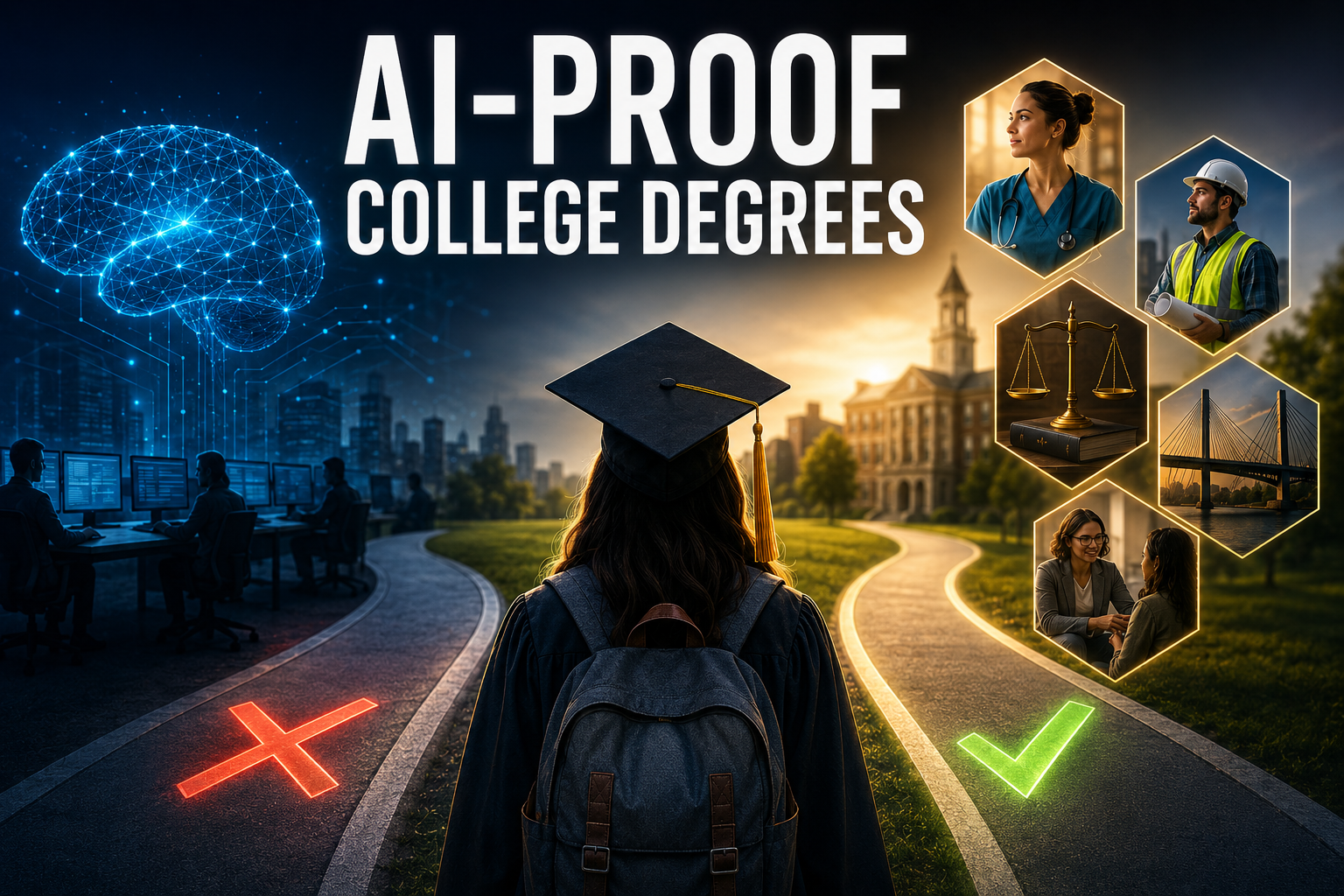
Why AI Systems No Longer Agree on STEM
PromptMarketMap Research Report | June 2026
For years, career advice followed a simple rule:
Go into STEM.
PromptMarketMap analyzed 50 realistic questions students and parents ask AI systems when evaluating college majors. The goal was not to determine which degree is objectively “best.” Instead, we wanted to understand which degrees AI recommendation systems consistently surface when users ask about salary, job security, automation risk, return on investment, and future demand.
The results revealed a surprising pattern.
AI systems no longer treat STEM as a single category.
Instead, recommendation engines increasingly divide degree programs into two groups:
- Degrees tied to physical systems, licensure, human judgment, and real-world accountability.
- Degrees tied to routine digital tasks and highly automatable knowledge work.
The result is what we call The Great STEM Split.
Our research on AI-proof jobs found a similar recommendation concentration effect among non-degree careers.
The 50 Questions Students and Parents Are Asking
The analyzed prompts covered five major themes:
AI Safety
- What AI-proof college degrees are there?
- Which majors will still matter in 2035?
- What college degrees are least likely to be automated?
- What are the best college majors for 2026?
- Are there any future-proof degrees?
Salary and ROI
- Which majors have the highest long-term earning potential?
- What degree provides the best return on investment?
- Which majors combine salary and job security?
- Are there any college majors safe from AI?
Healthcare
- Is a nursing degree still worth it?
- Will doctors be replaced by AI?
- What healthcare careers have the strongest future?
STEM
- Is computer science still worth it?
- Which engineering fields are safest?
- Is cybersecurity more secure than software development?
- What is better a civil engineering degree or a cybersecurity degree?
Business and Liberal Arts
- Is accounting safe from AI?
- What business majors remain valuable?
- Are humanities degrees still worth pursuing?
- Are these AI-resistant careers?
While the questions varied dramatically, the answers often converged on the same small group of degree programs. They all point to what is the future of higher education in the new world of AI.
The Degree Recommendation Concentration Effect
One of the clearest findings from this research is what we call the Degree Recommendation Concentration Effect.
Different questions produced remarkably similar recommendations.
A student asking about salary received many of the same recommendations as a student asking about AI safety.
A parent concerned about job security received many of the same recommendations as someone asking about long-term demand.
The justification changed.
The recommendations rarely did.
Most Frequently Recommended Degrees
| Rank | Degree Program |
|---|---|
| 1 | Nursing |
| 2 | Civil Engineering |
| 3 | Physician Assistant |
| 4 | Psychology / Counseling |
| 5 | Computer Science |
| 6 | Occupational Therapy |
| 7 | Mechanical Engineering |
| 8 | Education |
| 9 | Supply Chain Management |
| 10 | Construction Management |
Nursing emerged as the closest thing to a universal recommendation.
Regardless of whether users asked about AI, salary, flexibility, healthcare, or future job security, nursing repeatedly appeared near the top of recommendation lists.
Civil Engineering showed similar consistency.
Unlike many technology-focused degrees, civil engineering combines physical infrastructure, public safety responsibility, regulatory oversight, and long-term demand.
These characteristics appear highly attractive to modern recommendation systems.
The Great STEM Split
Historically, career advisors treated STEM as a single category.
AI recommendation systems increasingly do not.
Instead, STEM is being divided into two distinct groups.
Degrees Gaining Recommendation Visibility
- Civil Engineering
- Mechanical Engineering
- Biomedical Engineering
- Electrical Engineering
- Cybersecurity
- Environmental Engineering
Degrees Receiving More Caveats
- General Computer Science
- Statistics
- Generic Data Analytics
- Entry-Level Programming
- Routine Software Development
This does not mean Computer Science is disappearing.
Far from it.
Computer science graduates continue to command strong starting salaries and remain highly employable.
However, recommendation systems increasingly attach warnings, caveats, and specialization requirements to computer science that rarely appear with fields such as civil engineering or nursing.
The recommendation pattern is no longer:
Study STEM.
Instead, it is increasingly:
Study STEM connected to physical systems, infrastructure, security, regulation, or human decision-making.
The same recommendation patterns appear in software markets, where AI increasingly favors category leaders and specialized solutions.
The Licensure Premium
Another major pattern emerged throughout the research.
Degrees leading to professional licensure consistently received stronger recommendations.
Examples include:
- Nursing
- Physician Assistant
- Occupational Therapy
- Physical Therapy
- Law
- Counseling
- Engineering disciplines requiring professional licensure
Why?
Because licensure creates barriers that automation cannot easily remove.
A language model can generate information.
It cannot legally assume responsibility.
It cannot sign engineering plans.
It cannot hold a nursing license.
It cannot represent a client in court.
It cannot accept malpractice liability.
As a result, recommendation systems increasingly favor careers where society requires a licensed human to remain accountable.
This phenomenon creates what PromptMarketMap calls The Licensure Premium.
Similar recommendation behavior appears in education technology, where trust and accountability strongly influence AI recommendations.
Systems Ownership Beats Task Execution
Perhaps the most important trend uncovered in this research is the growing distinction between systems ownership and task execution.
Task Execution
Examples include:
- Basic coding
- Data entry
- Routine bookkeeping
- Content generation
- Standard reporting
Systems Ownership
Examples include:
- Nurse Practitioner
- Civil Engineer
- Cybersecurity Architect
- Supply Chain Director
- Attorney
- Clinical Counselor
Recommendation systems increasingly reward degrees that teach students how to manage, oversee, and make decisions about complex systems.
Degrees focused primarily on executing predictable tasks receive more scrutiny.
This distinction appears repeatedly throughout healthcare, engineering, business, and technology recommendations.
Degrees Losing Recommendation Visibility
Importantly, recommendation visibility is not the same as job extinction.
Many majors continue to provide value, even if AI systems recommend them less frequently.
However, several fields appeared repeatedly as cautionary examples.
Frequently Flagged Degrees
- General Liberal Arts
- Journalism
- Communications
- Generic Business Administration
- Entry-Level Computer Programming
- General Marketing
The common thread is not that these degrees lack value.
The common thread is that many of their traditional entry-level tasks are increasingly automated.
As a result, recommendation systems often suggest pairing these degrees with specialized technical, regulatory, or professional credentials.
The Rise of Hybrid Degrees
One of the strongest recommendation trends involved hybridization.
AI systems increasingly favor combinations such as:
- Psychology + Technology
- Business + Analytics
- Healthcare + Data Systems
- Engineering + AI
- Communications + Technical Expertise
Rather than replacing human professionals, AI is creating demand for workers who can combine domain expertise with technological fluency.
The most resilient educational pathways increasingly appear to be those that blend human judgment with AI-assisted workflows.
What Parents Should Know
Parent-focused prompts produced a different emphasis than student-focused prompts.
Students typically asked:
- What should I major in?
- What pays the most?
- What is safest from AI?
Parents asked:
- What degree offers the best ROI?
- Which majors lead to stable employment?
- Which careers justify the tuition cost?
Because of this difference, nursing, engineering, physician assistant programs, and construction management appeared even more frequently in parent-focused recommendation scenarios.
These degrees consistently balance:
- Strong earnings
- Lower automation risk
- Professional demand
- Clear career pathways
Conclusion
The biggest surprise from this research was not that nursing ranked first.
The biggest surprise was that AI systems no longer treat STEM as a unified category.
Instead, recommendation engines increasingly distinguish between:
- Physical versus digital work
- Licensure versus non-licensure
- Systems ownership versus task execution
- Human accountability versus algorithmic execution
The result is a new recommendation hierarchy. Jobs don’t necessarily mean AI Proof College Degrees.
Nursing, civil engineering, physician assistant programs, counseling, and other human-centered professions increasingly dominate recommendation results.
Meanwhile, traditionally safe white-collar pathways receive more caveats, specialization requirements, and warnings than they did just a few years ago.
The future of higher education may not be a choice between humans and AI.
It may be a choice between degrees that use AI as a tool and degrees that compete directly against it.
For students entering college in 2026, that distinction may be one of the most important career decisions they make.
Explore the full PromptMarketMap research library.